
How SDS and REACH data feed a Digital Product Passport

Most of the chemical data a Digital Product Passport needs already exists in your safety data sheets and REACH dossiers. The hard part isn't finding it. It's getting it out of documents built for one purpose and into a structured, product-level record that buyers, recyclers and regulators can query.
DPP conversations usually start with QR codes, data carriers and platforms. The chemical content tends to come last, and that is where projects stall. This post explains which chemical data a passport asks for, where it already sits in your business, and how to connect the two.
What a passport has to say about chemicals
Under the Ecodesign for Sustainable Products Regulation (ESPR), information on substances of concern is a default requirement, and it will usually be carried in the DPP. ESPR came into force on 18 July 2024. The Commission's DPP Registry went live on 20 July 2026, and the first passport deadline, for certain large batteries, falls on 18 February 2027.
ESPR Article 2(27) defines a substance of concern as one that is:
- on the REACH Candidate List of SVHCs
- harmonised under CLP (Annex VI) in hazard classes including CMR, endocrine disruption, PBT/vPvB, PMT/vPvM, respiratory or skin sensitisation, chronic aquatic toxicity, ozone depletion and STOT
- a persistent organic pollutant under the POPs Regulation
- or listed in a product-specific delegated act because it hinders reuse or recycling
For each one, Article 7(5) asks for:
- its name and identifiers (IUPAC name, EC and CAS numbers)
- where it is in the product
- its concentration, maximum concentration or range, at product, component or spare-part level
- instructions for safe use
- information for disassembly, reuse, recycling and end-of-life
SVHCs can't be exempted above 0.1% w/w (Article 7(6)). Thresholds and exemptions for each product group are set in delegated acts, and the JRC is already drafting these, for example for steel intermediate products.
Where that data already lives
Nearly every item on that list already exists somewhere in a chemical business. It's just spread across documents written for other audiences.
Source | What it holds | Feeds which passport item |
SDS section 1 and 3 | Substance or mixture identity, EC and CAS numbers, composition and concentration ranges | Name and identifiers; concentration |
SDS section 2 and 15 | Classification, hazard statements, SVHC and authorisation status | Whether it counts as a substance of concern |
SDS section 7, 8 and 13 | Safe handling, exposure controls, disposal | Safe use; end-of-life |
REACH dossier (IUCLID) | Verified substance identity, composition and impurities, classification, uses | The authoritative identity and hazard record behind the SDS |
REACH Article 33 and SCIP notifications | SVHCs above 0.1% w/w in articles, and where they sit | Location in the product; concentration |
Supplier declarations | Composition of bought-in materials and components | Fills the gaps your own data can't |
How the data flows
The passport shouldn't pull from PDFs. Data from each source goes into one structured record first. There, identities are matched, substances of concern are flagged, and concentrations are worked out for each product.
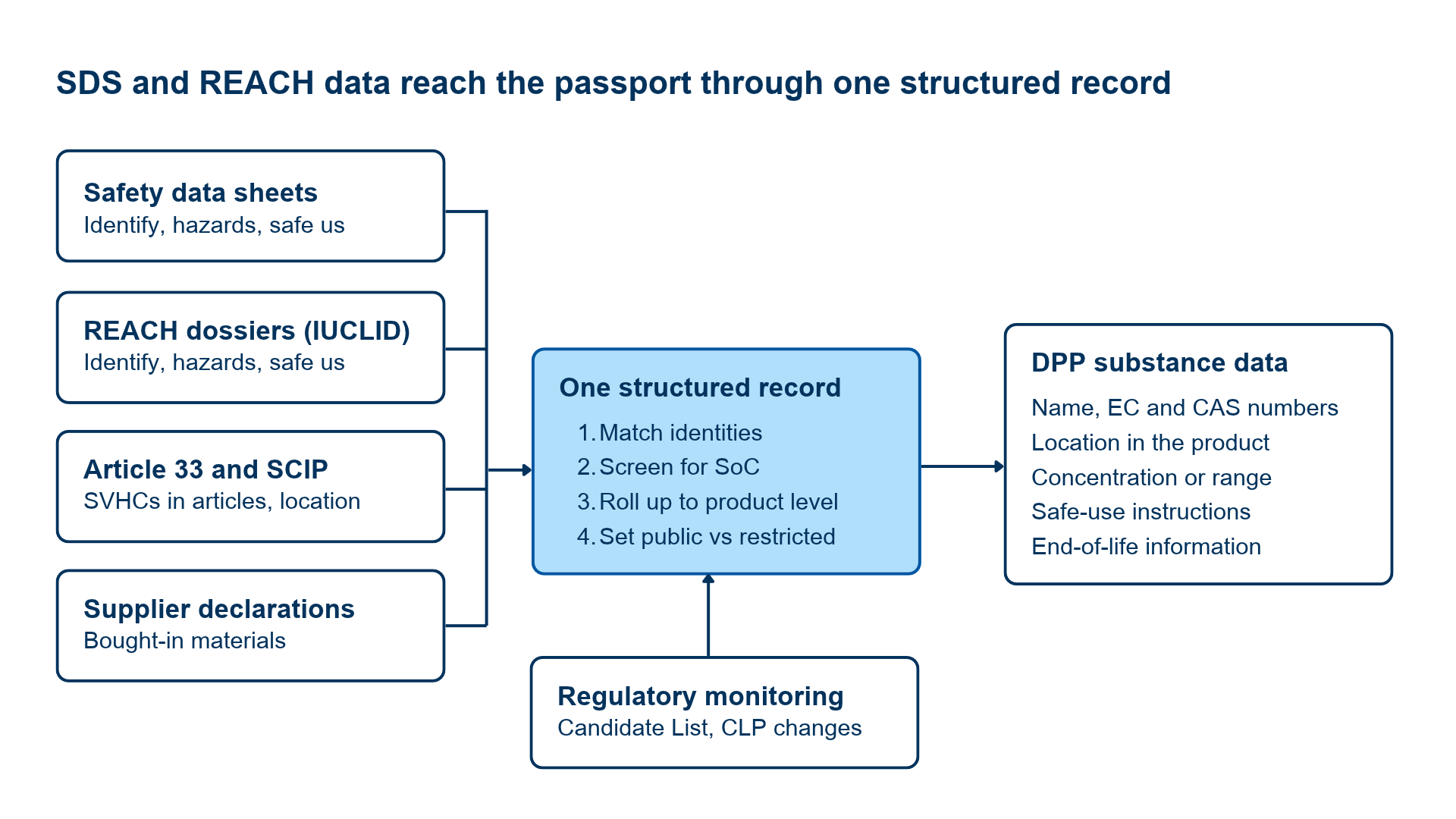
Regulatory monitoring keeps that record up to date, so a new Candidate List entry reaches the passport without anyone rebuilding it by hand.
Where it usually goes wrong
- Treating the SDS as the data source. An SDS is a document, often a PDF. Concentrations are given as ranges and are sometimes withheld as confidential. A passport needs structured fields, so the underlying data has to be pulled out, not copied.
- Mixture data versus product data. An SDS describes a substance or mixture as supplied. A passport describes a finished product or component. Getting from one to the other means tracking what goes into each product, then working out concentrations at product level.
- Identities that don't match. If the substance name or EC number differs between your IUCLID dossier, your SDS and your supplier's declaration, the passport will expose it. Fix this before you publish anything.
- Static data in a moving system. The Candidate List grows, CLP classifications change and new hazard classes are added. A substance that's fine today can become a substance of concern next year, so passport data needs the same regulatory monitoring as your SDS.
- Confidentiality. Composition is commercially sensitive. Decide early which data is public and which goes only to authorities or recyclers, rather than finding out at launch.
Where to start
- Screen your portfolio. Check which of your substances meet the Article 2(27) criteria today, and which are likely to as the Candidate List and CLP move on.
- Make IUCLID your single source of identity. Line up substance names, identifiers and compositions across your dossiers, SDSs and supplier data.
- Map before you build. For one pilot product, trace each passport field back to its source and record the gaps.
- Put it in a system, not a spreadsheet. Passport data needs version control and an update whenever the regulation changes.
Penman helps with each of these steps. Our regulatory and scientific teams screen portfolios for substances of concern and keep IUCLID dossiers and SDSs consistent. Active Steward™ holds that data in one structured place, ready to feed a Digital Product Passport. [Talk to us about DPP readiness.]
FAQ
Does every product need a passport now? No. Requirements apply one product group at a time, through delegated acts under ESPR. The first deadline, for certain large batteries, is 18 February 2027. Other groups follow as their delegated acts are adopted.
Can I just link my SDS to the passport? Not on its own. An SDS describes a substance or mixture as supplied, often as a PDF with concentration ranges. A passport needs structured data about the finished product, so the SDS is a source rather than the answer.
What concentration threshold applies? SVHCs on the Candidate List can't be exempted above 0.1% w/w. For other substances of concern, thresholds and exemptions are set in each product group's delegated act.
Will I have to publish my full composition? Not necessarily. Each delegated act sets who can see which passport data. Decide early which information is public and which is shared only with authorities or recyclers.
We sell chemicals, not finished products. Does this affect us? Yes, indirectly. Your customers will need substance data from you to build their own passports. Expect more detailed requests, beyond what an SDS gives them.
What happens when the Candidate List is updated? A substance can become a substance of concern overnight. Passport data needs the same regulatory monitoring as your SDSs, so updates reach the passport without being rebuilt by hand.
Sources
- Regulation (EU) 2024/1781 (ESPR), EUR-Lex
- The Digital Product Passport Registry is now live, European Commission, 20 July 2026
- JRC draft report: Requirements on substances of concern in ESPR steel intermediate products (2026)
- CIRS: JRC method for identifying and tracking substances of concern in products, 2 Dec 2025